
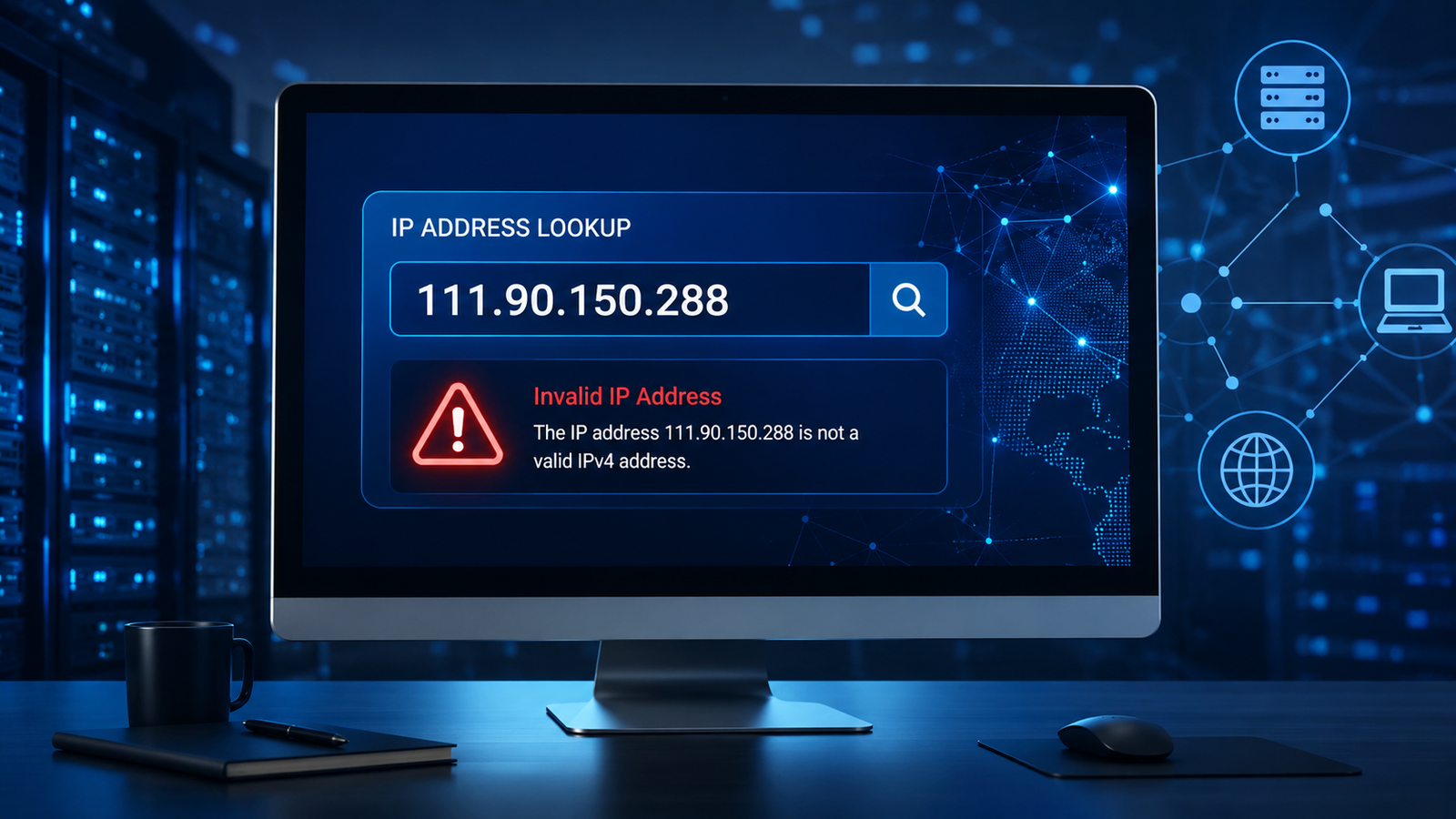
111.90.150.288 IP Check Is It Valid or Invalid?
111.90.150.288 looks like an IPv4 address, but it isn’t valid. The problem is the last number, 288, because IPv4 sections can only range from 0 to 255. If you found this IP in a log, message, or security report, it was likely entered or copied incorrectly. Check the original address before trying to trace or identify it.
What Is 111.90.150.288?
The string 111.90.150.288 has the basic visual format of an IPv4 address because it contains four numerical parts separated by periods. However, formatting alone does not make an IP address valid. IPv4 uses four 8-bit numbers, commonly called octets, and each octet can range only from 0 through 255. The first three sections here—111, 90, and 150—fall within that range, but 288 does not. Therefore, 111.90.150.288 cannot function as a normal public or private IPv4 address.
Why 111.90.150.288 Is Invalid
The problem with 111.90.150.288 is the last number. An IPv4 address has a maximum value of 255 in each section because every octet represents eight binary bits. Once an octet reaches 256, it is already outside the IPv4 range. Since 288 is 33 numbers higher than 255, the complete address fails basic IPv4 validation. This is useful to know because an invalid IP should not be treated as evidence of a particular website visitor, server, company, country, or internet service provider.
What Is the Correct IPv4 Range?
A valid IPv4 address follows the pattern 0.0.0.0 through 255.255.255.255, although not every address in that overall numerical range is available for ordinary public use. Each of the four octets must independently fall between 0 and 255. For example, 111.90.150.28 is structurally valid, while 111.90.150.288 is not. This small distinction matters when investigating technical information because one incorrectly typed digit can point an investigation in the wrong direction.
Could 111.90.150.288 Be a Typo?
Yes, and a typing or transcription mistake is one of the most likely explanations. Someone may have accidentally added an extra digit, copied an address incorrectly, or changed the original value while recording it. Possible addresses such as 111.90.150.28, 111.90.150.228, or another similar-looking value are technically possible, but there is no reliable way to determine which one was intended without seeing the original source. Guessing the correction could lead to completely different network information.
Can You Geolocate 111.90.150.288?
You cannot reliably geolocate 111.90.150.288 because it is not a valid IPv4 address. IP geolocation services require a valid address that can be matched against network allocation and geographic databases. If a website or tool accepts this value, that does not necessarily mean its result is accurate. A malformed address may be rejected, normalized incorrectly, or produce an error. The safest approach is to verify the original IP before attempting to determine its approximate country, region, city, network, or provider.
Does 111.90.150.288 Belong to an ISP?
There is no legitimate ISP assignment that can be reliably associated with 111.90.150.288 as written because the address itself is invalid. Internet service providers, hosting companies, universities, businesses, and other organizations receive valid IP ranges, but an address with an octet greater than 255 cannot represent a standard IPv4 endpoint. If you saw this value connected to an ISP name somewhere online, it is worth checking the original data carefully rather than assuming the information is correct.
Is 111.90.150.288 a Public IP Address?
No. 111.90.150.288 is not a valid public IPv4 address. Public IP addresses are globally routable addresses that follow the same basic IPv4 rules, including the 0–255 limit for every octet. Although the first three numbers look normal, the final value makes the entire address invalid. This means it should not be interpreted as the public IP of a person, router, website, server, or other internet-connected device without first confirming the correct address.
Is 111.90.150.288 a Private IP Address?
No. It is not a valid private IPv4 address either. Common private IPv4 ranges include 10.0.0.0/8, 172.16.0.0 through 172.31.255.255, and 192.168.0.0/16. More importantly, regardless of whether an address is intended for a private network or the public internet, every IPv4 octet must remain between 0 and 255. The number 288 immediately makes this particular address invalid.
What Should You Do If You Found This IP in a Log?
If 111.90.150.288 appears in a server log, firewall record, analytics report, email header, or security notification, do not immediately assume it represents a real connecting device. First, inspect the surrounding information and verify whether the value was copied correctly. Look for nearby entries containing similar addresses, check the original log format, and confirm whether the application generated the value or someone manually entered it. A malformed IP could result from an application error, bad parsing, corrupted data, a simple typo, or incorrect reporting.
Could It Be Related to a Cybersecurity Incident?
An invalid IP address by itself does not prove that hacking, scanning, fraud, or another cyberattack occurred. Security logs can contain malformed data for many harmless reasons, including software bugs and incorrect parsing. If you encountered 111.90.150.288 during a security investigation, the better approach is to examine the complete event, including timestamps, ports, protocols, request paths, usernames, user agents, authentication events, and other surrounding records. The invalid address is a clue that the data needs verification, not proof of malicious activity.
How to Check Whether an IP Address Is Valid
Checking an IPv4 address is straightforward. Separate the address into its four sections and confirm that every section is an integer between 0 and 255. For 111.90.150.288, the values are 111, 90, 150, and 288. The first three pass the basic range test, but 288 fails, so the complete address is invalid. This simple check should happen before using IP lookup databases, WHOIS services, geolocation tools, or reputation checkers.
What Is the Difference Between IPv4 and IPv6?
IPv4 is the familiar address format made of four decimal sections, such as 192.168.1.1. IPv6 is a newer addressing system designed to provide a much larger number of addresses and uses hexadecimal characters separated by colons, such as 2001:db8::1. The rules for IPv6 are completely different from IPv4, so an IPv6 address should not be judged using the four-octet IPv4 format. In the case of 111.90.150.288, however, the notation clearly resembles IPv4 and fails its basic numerical requirements.
Why Accurate IP Information Matters
A small error in an IP address can have surprisingly large consequences. An incorrect address may lead someone to identify the wrong internet provider, investigate the wrong server, report an innocent organization, or misunderstand a security event. This is especially important for website owners and administrators who use IP information to analyze traffic, investigate suspicious requests, or troubleshoot access problems. Always work from the original technical record whenever possible instead of relying on a copied or manually retyped address.
Common Mistakes When Searching an IP Address
One common mistake is assuming that anything written in four dotted numbers must be a valid IPv4 address. Another is using an IP lookup website without checking the address first. People may also confuse an invalid IP with a blocked address, private address, or suspicious address. These are different concepts. An invalid address simply fails the technical rules for IPv4, while a valid address can still be private, reserved, dynamically assigned, shared, or associated with potentially unwanted activity.
Can an Invalid IP Be Traced to a Person?
No reliable personal identification can be made from 111.90.150.288 because it is not a valid IPv4 address. Even with a valid IP, an IP address generally does not directly reveal a person’s name, home address, or exact physical location. Internet providers may hold subscriber information, but access to such records is subject to applicable laws, policies, and procedures. Anyone claiming that this invalid address alone identifies a specific person should be treated with caution.
Should You Block 111.90.150.288?
There is generally no reason to block 111.90.150.288 as though it were a normal source IP, because it is not a valid IPv4 address. If the value appears in a security system, first determine how the system generated or recorded it. Blocking a guessed replacement address could accidentally block a legitimate user or server. For administrators, it is usually better to validate the data and investigate the actual connection details before creating firewall rules or access-control policies.
How Website Owners Can Handle Invalid IP Data
Website owners should validate incoming IP information before storing, analyzing, or using it for security decisions. Modern web applications may receive client information through proxies, load balancers, application gateways, or forwarding headers, which makes careless IP parsing especially risky. If your analytics or security platform reports an impossible IPv4 value such as 111.90.150.288, investigate the software and headers involved rather than assuming the visitor actually connected from that address. Proper validation helps keep security logs and traffic reports trustworthy.
What If You Meant a Different IP Address?
If 111.90.150.288 was copied from another source, check the original value carefully. Look for an extra digit, a missing separator, or a transcription mistake. For example, 111.90.150.28 is a structurally valid IPv4 address, while 111.90.150.288 is not. However, it would be wrong to assume that 111.90.150.28 is the intended address without confirmation. When dealing with IP investigations, accuracy matters more than making a quick guess.
Conclusion
The key takeaway is simple: 111.90.150.288 is not a valid IPv4 address because IPv4 octets cannot exceed 255. If you encountered this value online, in a security report, or inside website logs, the smartest next step is to verify the original information rather than trying to identify an owner or location from an invalid address. A single incorrect digit can completely change the result of an IP lookup. Once the correct IP is confirmed, it can be checked for its network, approximate geographic information, and other publicly available technical details. Until then, treat 111.90.150.288 as malformed IP data rather than a traceable internet address.
Frequently Asked Questions
Is 111.90.150.288 a valid IP address?
No. 111.90.150.288 is not a valid IPv4 address because the final octet, 288, is greater than the permitted maximum of 255. Every IPv4 octet must contain a value from 0 to 255.
What is wrong with 111.90.150.288?
The problem is the number 288 at the end. IPv4 addresses contain four octets, and each octet must be between 0 and 255. Because 288 exceeds that limit, the complete address is invalid.
Can I find the location of 111.90.150.288?
Not reliably. Since the address is invalid, standard IP geolocation information cannot be trusted for it. You should first find and verify the correct IP address.
Could 111.90.150.288 be a real server IP?
Not as a standard IPv4 address. A normal IPv4 server address cannot contain an octet greater than 255. If this value appears in a server log, the underlying data should be checked for an error or typo.
Is 111.90.150.288 dangerous?
The address itself cannot be classified as dangerous because it is invalid. Its appearance in a log or message does not automatically indicate malware, hacking, or fraud. The surrounding technical information is needed to understand what happened.
Read also: What Is Preeyaporn47833? A Complete Guide


One thought on “111.90.150.288 IP Check Is It Valid or Invalid?”